
Online Casino Licenses in Canada: Regulations and Player Protection
For players in Canada, an online casino license is only part of the legal picture. Always check the operator, exact domain and local law before depositing.
An online casino license matters most when something goes wrong. A casino may display the MGA, UKGC, Curaçao or Anjouan name in its footer, but what does that actually tell you about the company holding your money?
Licensing systems are changing. Some authorities are strengthening supervision, while new offshore options are attracting operators with different budgets and business models. The result is a market in which the words “licensed casino” can describe very different levels of oversight and player protection.
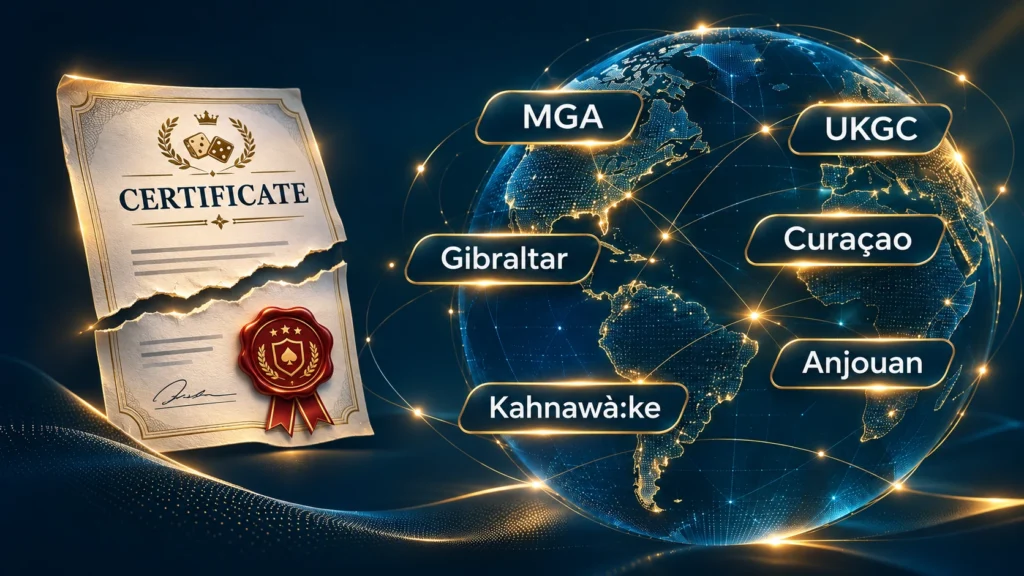
This guide explains what gambling authorities check, how licensing jurisdictions differ, what happens during a payment dispute, and why software licensing matters as much as the badge on the casino website.
It is not a ranking of licensing authorities and it does not treat an offshore license as proof of fraud. The goal is to help players ask better questions and verify the facts before depositing or uploading identity documents.
Important to know: Displaying a licensing authority’s name, logo or a link to its website does not automatically prove that a casino holds an active and valid license. Always check the current license status in the official register.
What Does an Online Casino License Actually Mean?
An online casino license is an authorization granted under the rules of a particular jurisdiction. A jurisdiction is simply the country or territory whose laws and authorities govern a specified activity.
Depending on the system, the regulator may assess ownership, financial arrangements, identity checks, responsible gambling tools, technical standards, anti-money-laundering controls and complaint procedures. The license tells you who is supposed to supervise the operator; it does not guarantee that every transaction will be trouble-free.
There is also a distinction between B2C licenses, used by operators serving players directly, and B2B or supplier licenses, used by businesses providing gambling software or other regulated technology. A software supplier’s authorization is not a substitute for the casino operator’s permission.
Established Casino Regulators: MGA, UKGC and Gibraltar
Casino licensing is not one worldwide system. The starting point for understanding the differences is to look at several established regulators with publicly documented rules, licensing records and complaint procedures. This is not a ranking: the practical safeguards depend on the operator, the type of license and the player’s jurisdiction.
Malta — Malta Gaming Authority (MGA): The MGA supervises licensed gaming operators and certain gambling suppliers under different authorization categories. Players can consult its public licensee register, check the entity behind a casino and review the applicable complaint and independent dispute-resolution routes. Its player information helps explain the process.
Great Britain — UK Gambling Commission (UKGC): The UKGC publishes a searchable public register and operating requirements for businesses licensed to serve the Great Britain market. Eligible unresolved customer disputes can be referred to an approved alternative dispute resolution (ADR) provider, subject to the applicable rules. The regulator and ADR provider have different roles.
Gibraltar — Gambling Commissioner and Gambling Division: Gibraltar publishes license-holder information and provides a complaints route. That does not mean the authority can award compensation in every individual case; the scope of its powers matters.
Other established frameworks include the Isle of Man and Kahnawà:ke, each with its own rules and oversight arrangements. None of these licenses automatically authorizes a casino to offer every gambling product in every country. Their main relevance is that players can investigate who supervises the operator and what happens when a dispute arises.
Major Casino Licensing Jurisdictions Compared
The table below is not a safety ranking. It highlights practical differences: the supervisory body, the availability of licensing information, and where players may look for further verification. Actual protection depends on the relevant license, the regulator’s powers, the operator and the player’s market.
| Jurisdiction | Authority / framework | What matters to players | Official reference |
|---|---|---|---|
| Malta | Malta Gaming Authority (MGA) | License register, player protection requirements and structured complaints / ADR. | Verify MGA license |
| Great Britain | UK Gambling Commission (UKGC) | Public register, published conditions, enforcement records and approved ADR providers. | UKGC register |
| Gibraltar | Gambling Commissioner / Gambling Division | Listed licensees and complaint procedures, with limits to direct compensation powers. | License holders |
| Isle of Man | Gambling Supervision Commission | An established licensing and supervisory framework, including operator and AML requirements. | Government information |
| Curaçao | Curaçao Gaming Authority (CGA) | Reformed LOK system, direct licensing and mandatory ADR arrangements for applicable B2C operators. | CGA register |
| Kahnawà:ke | Kahnawà:ke Gaming Commission | Its own interactive gaming authorizations and an operator/domain holder list. | Permit holders |
| Nevis | Nevis online gaming framework | A newer statutory system; check the relevant authority and the exact authorization. | Official legislation news |
| Anjouan | Anjouan Gaming / associated authorities | A register is offered by the licensing framework, but its legal authority is contested. | Claimed license register |
| Mohéli / Mwali | Mwali-associated licensing structures | Separate offshore arrangements; do not assume a unified Comoros national license. | Verify authority and status independently |
| Costa Rica | Business and tax framework, not a comparable B2C casino regulator | Company or operational paperwork should not be confused with a regulated casino license. | Legal framework |
A licensing authority’s name is not a verdict: For a specific casino, always check the legal operator, current license status, permitted activities and — where listed — the exact domain. The table describes frameworks, not endorsements.
Why Is the Online Gambling Licensing Market Changing?
Online gambling has expanded into many markets, but there is no single worldwide casino license. At the same time, regulators have different priorities: player protection, financial supervision, tax collection, market access and the enforcement of local rules.
Licensing can be expensive and operationally demanding. A smaller or recently launched casino may not be able to build the same compliance team or meet the same capital requirements as an established international group. That can help explain why some operators explore alternative jurisdictions. A lower-cost license is not, by itself, evidence of dishonest intentions.
However, lower entry costs and simpler procedures do not necessarily provide the same practical safeguards when a player disputes a withdrawal. Players should consider what stands behind the license rather than making assumptions about the operator’s motives.
Curaçao: From Sub-Licensing to a Reformed System
Curaçao was long associated with a master-license and sub-license model. Its National Ordinance on Games of Chance (LOK) took effect on 24 December 2024, introducing a different, more direct licensing and supervision framework.
The Curaçao Gaming Authority (CGA) publishes regulatory documents, application requirements and policies covering the new system. The reform also established requirements for independent Alternative Dispute Resolution (ADR) providers, an important development for players with unresolved complaints.
Still, introducing stronger written rules and demonstrating their effectiveness across the industry are different things. We should judge the newer framework by documented enforcement and real complaint-handling results, rather than relying only on Curaçao’s older reputation.
Anjouan, Mohéli and Emerging Offshore Options
Some international casino brands have changed licensing arrangements, and newer systems such as Anjouan and Nevis have drawn attention. That does not establish a global statistical trend in the number of Curaçao versus Anjouan licensees. Comparable, comprehensive historical figures would be needed to make that claim.
Anjouan and Mohéli (Mwali) are both islands in the Union of the Comoros, but separate licensing structures use their names. They should not be treated as one unified “Comoros license”. Anjouan’s offshore licensing framework is also the subject of a serious dispute over legal authority: Comorian national authorities have challenged the system, while its representatives maintain that it is valid. The reported dispute and parties’ positions provide useful context.
This dispute matters when assessing what a license actually proves, but it does not mean that every casino presenting an Anjouan authorization is fraudulent. What the player needs to establish is whether the operator is identifiable, how the claimed authorization can be checked and which independent protections can realistically be used.
Nevis also adopted legislation in 2025 to establish an online gaming framework, showing that new jurisdictions continue to enter the sector. See the official Nevis government announcement.
Costa Rica: Company Registration Is Not a Casino License
Costa Rica is frequently mentioned in discussions about offshore gambling businesses. However, registering a company or holding a general business permit in Costa Rica is not the same as receiving a dedicated remote casino operator license from a gambling regulator.
Costa Rican law addresses certain electronic betting and data-processing businesses, including through Law No. 9050 and related rules. That should not be presented as the equivalent of a UKGC or MGA B2C gambling authorization with the same player complaint and game supervision arrangements.
When a casino describes itself as “Costa Rica licensed”, players should ask exactly which document has been issued, by whom, for what activity and with what oversight.
Casino Player Protection: What Is Actually Covered?
Player protection goes well beyond an “18+” badge in the footer. Regulatory requirements can cover deposit and loss limits, time-outs, self-exclusion, identity verification, fair terms, financial controls and complaint handling.
Self-exclusion allows a player to restrict access to gambling, sometimes across many operators through a national scheme. The UK’s GAMSTOP is an example; it is an exclusion service, not an organization that recovers disputed winnings. For the broader topic, see our Responsible Gambling guide.
How operators hold or account for customer balances also matters. Protection rules may require information and safeguards for player funds, but a license should not be mistaken for an unconditional government guarantee of every balance or withdrawal.
In practice, the most useful question is not simply “Does this casino have responsible gambling tools?” but “Can the player use them effectively, and is the operator accountable if the rules are ignored?”
Complaints and Dispute Resolution: What If a Casino Refuses to Pay?
Imagine winning €5,000, completing identification checks and then seeing the withdrawal refused. The operator may claim that bonus rules were breached, that additional documents are needed or that a game result was invalid. Sometimes there is a legitimate explanation; sometimes there is a genuine dispute.
What matters is whether the player can challenge the decision through a clear process: a written complaint to the casino, access to independent review where available, and potentially regulatory or legal channels. A regulator is not necessarily a court or a debt-collection agency.
What Is ADR — Alternative Dispute Resolution?
ADR means Alternative Dispute Resolution: a way for an independent organization to examine eligible disputes without starting a court case. The process may cover withdrawals, account restrictions, disputed bonuses or other contractual disagreements. Eligibility rules and whether a decision binds the operator vary.
In Great Britain, licensed operators must provide access to approved ADR providers for qualifying unresolved disputes. The internal complaints stage can run for up to eight weeks, although a deadlock can be reached sooner. See the UKGC’s player-facing ADR guide.
Under the MGA framework, licensed operators have prescribed complaints and ADR arrangements, while the MGA’s player support function has a different role from an independent dispute adjudicator. Curaçao’s newer framework also requires CGA-approved ADR arrangements for B2C licensees; operators bear the associated costs under its policy. The CGA regulatory documents describe this newer requirement.
Gibraltar publishes a complaints procedure for Gibraltar licensees, with defined conditions and limits. The regulator does not operate as an ordinary court granting compensation in every individual monetary dispute.
Organizations such as eCOGRA and IBAS provide dispute-resolution services in the cases and operator arrangements they cover. Always check which ADR organization the specific casino names in its own Terms and Conditions.
What Should a Player Keep as Evidence?
If a dispute begins, save the account terms applicable when you registered, the bonus offer you accepted, dated withdrawal requests, chat transcripts, payment confirmations and any reason the casino gives for its decision. Ask for a written final response, not just another live-chat promise.
A clearly documented complaint is easier to assess than an exchange of accusations. If the issue is unresolved, follow the operator’s stated escalation process and check whether the relevant regulator accepts a regulatory report or an individual complaint.
Canada: Local Online Casino Rules and Licensing
Canada — local rules: Canada does not operate one nationwide online-casino licensing system. Provinces establish their own arrangements. In Ontario, private online gaming operators must register with the AGCO and enter into an operating agreement with iGaming Ontario. Verify the precise website in the official regulated-market directory; Ontario registration does not by itself authorize play from every other province. Elsewhere in Canada, check the relevant provincial rules and lottery or gaming authority.
Official reference: Alcohol and Gaming Commission of Ontario (AGCO); iGaming Ontario
The casino website may be accessible from almost anywhere, but gambling law is not a single worldwide rulebook. Countries — and sometimes individual states or provinces — decide which gambling products may be offered to people in their territory and who supervises those products.
There is no single online casino license that automatically grants access to every EU member state. A Malta-licensed casino is not automatically licensed to serve the Dutch or German market, and the permitted product range may differ even between neighboring countries.
These differences also affect the complaints route: a player may face an international operator, a foreign governing law and a separate domestic regulator. The following table offers examples, not individualized legal advice.
| Market | Supervisor | Key point | Official reference |
|---|---|---|---|
| Ontario | AGCO / iGaming Ontario | Private operators need AGCO registration and an agreement with iGaming Ontario; confirm listed sites. | Ontario regulated gaming directory |
| Other Canadian provinces | Relevant provincial gambling authority | Provincial approaches differ. Ontario authorization does not automatically cover other provinces. | Ontario jurisdiction explanation |
An Ongoing Cross-Border Legal and Market Debate
International casino companies want access to customers across borders, while governments pursue their own licensing, taxation, enforcement and consumer-protection goals. These interests do not always align. Some international questions continue to be contested, and the market continues to evolve.
That does not mean each country’s rules are optional or that all legal situations are unresolved. Many markets define licensing requirements very clearly. Players should distinguish a foreign authorization from permission to offer a particular product where they live.
Unlicensed Casinos, Missing License Details and Fake Claims
Three situations should never be treated as identical.
Verified license: an operator can be matched to a current authorization, subject to the scope of that authorization. Unverified license information: the website does not provide enough detail, or a public check has not established its status. False license claim: the casino uses invented details, copies another company’s certificate or claims a regulator never authorized it.
Missing public disclosure is a transparency and verification concern, not automatic proof of fraud. Proven impersonation or forged licensing information is a much more serious sign of deception.
Always check the exact domain where you intend to register. A legitimate company can hold a genuine license without that license covering an unrelated lookalike website. The UKGC public business register includes company names, license status and declared domains; the MGA also provides a licensee and URL checker.
For examples of fake casino sites, forged badges, manipulated bonuses and withdrawal scams, see our related Scam Casinos: How to Spot and Avoid Fake Online Casinos guide.
Important to know: Displaying a licensing authority’s name, logo or a link to its website does not automatically prove that a casino holds an active and valid license. The actual license status should be checked in the official regulator’s register.
Casino Software Licenses and Counterfeit Games
A casino operator’s license is only part of the picture. Games can come from separate studios, aggregators and technology platforms. Depending on the jurisdiction, the supplier may need its own B2B authorization, and games may be subject to independent technical testing.
Two useful terms are RNG (Random Number Generator), the technology used to determine random outcomes, and RTP (Return to Player), the game’s theoretical long-term payout percentage under its mathematical design. An RTP figure shown on a screen is not itself proof that the displayed game is an authentic, certified release.
Original Games, Unauthorized Distribution and Copies
There are at least two different risks. A genuine supplier’s product may appear on a site that does not hold the necessary local gambling authorization. Separately, an unauthorized party can create a counterfeit or manipulated imitation of a familiar game, potentially without the manufacturer’s controls or independent testing.
Play’n GO publishes information about its licenses and certification, including concerns about unauthorized copies of its products. The UK Gambling Commission has also warned about licensed software appearing on unlicensed gambling sites.
A recognizable provider logo does not prove that the casino is authorized or that every game in its catalogue is genuine. Where confirmation is available, check whether the actual provider or an authorized distributor can substantiate the relationship.
Can Casino Review Sites and Player Comments Help?
Yes — especially as a supplementary source. Established review platforms can collect operator information, withdrawal rules, complaint histories and responses to disputes. Repeated problems reported across independent sources may reveal patterns that a casino’s promotional website never mentions.
However, player comments are not a reliable verdict by themselves. A negative review may reflect a misunderstood bonus condition or a difficult but legitimate verification process; positive reviews may be incentivized, selective or fake. Review websites may also earn affiliate commissions from the casinos they cover, which readers should take into account.
Sites such as Casino Guru and AskGamblers can help identify complaint patterns. Look beyond the star rating: what was disputed, did the operator respond, was the case resolved, and is the same issue recurring?
Reviews are useful indicators, not official licensing decisions. They should add to — never replace — checks of the operating company, license and exact domain.
How to Verify an Online Casino Before Depositing
You do not need legal training to make a meaningful first check. A few minutes can uncover serious contradictions before you transfer money or upload sensitive documents.
- Identify the legal operator. Find the contracting company in the Terms and Privacy Policy. Are the details consistent?
- Open the official regulator’s register. Check the company, license number, activity type and current status rather than trusting a footer badge.
- Check the exact casino domain. If domains are listed, the one you are using should be covered.
- Read the withdrawal and KYC conditions. Check payout limits, processing rules, documentation requirements and bonus restrictions.
- Find the complaints procedure. Is a real contact point provided? Is there an independent ADR body, and what issues can it handle?
- Check software claims where possible. A familiar game or provider logo is not enough if the operator’s background is unclear.
- Compare independent evidence. Look for repeated withdrawal complaints, conflicting brand histories and meaningful responses from the operator.
- Check your own market’s rules. Being able to open a website does not automatically mean that the casino is locally licensed.
Practical rule: Check the operator + current license + exact domain + withdrawal terms before you deposit. No single check provides a 100% guarantee.
Online Casino Licenses FAQ
What is a casino license?
It is an authorization to offer certain gambling services under a defined legal framework. Its requirements and geographical scope depend on the issuing jurisdiction and the type of license.
Does an offshore casino license mean the casino is a scam?
No. Offshore describes a licensing or operating location, not proof of dishonesty. The important questions are who operates the site, whether its license can be verified and what player protections are available.
Is a casino licensed if it displays the MGA or UKGC logo?
Not necessarily. Logos and links can be copied. Search the regulator’s official register for the company, current authorization and exact domain wherever those details are available.
What is the difference between a B2C and a B2B gaming license?
A B2C authorization generally covers the operator offering gambling directly to players. A B2B or supplier license covers regulated software or related services. The two do not automatically replace each other.
What is ADR and can it force a casino to pay?
Alternative Dispute Resolution is independent review of eligible complaints without court proceedings. Whether an outcome binds the operator depends on the regulator’s rules and the applicable ADR scheme; it is not a universal payout guarantee.
Does Ontario iGaming registration cover all Canadian provinces?
No. A license from Malta or another offshore or overseas jurisdiction does not override local restrictions. Ontario registration only supports the applicable Ontario framework and does not automatically extend to other Canadian provinces.
Does a Costa Rican business registration count as a casino license?
No. Company registration or general business paperwork is not equivalent to a dedicated gambling operator license supervised for casino activity and player complaints.
Are Anjouan and Mohéli the same gambling jurisdiction?
No. Both names refer to islands in the Comoros, but different licensing arrangements use those names. The Anjouan framework is also involved in a dispute over its legal authority.
How can I tell if a casino game is genuine?
Start by checking the operator and license, then consider whether the software supplier confirms the game or business relationship. Familiar logos, visual design and an RTP label alone cannot prove authenticity.
What should I do if a casino refuses my withdrawal?
Request the reason in writing, keep the terms and account records, follow the casino’s complaint procedure, and check whether its license provides access to an appropriate ADR service or regulator. Do not automatically pay unexpected new fees to “unlock” a balance.
Are casino review comments reliable?
They can show useful patterns, but individual ratings can be incomplete, misleading or manipulated. Compare multiple sources and focus on documented complaints, operator responses and outcomes rather than a single score.
Casino Review Examples by Licensing Framework
These examples are not a casino ranking or a recommendation. They illustrate how license arrangements can differ between operators and even between markets served by the same brand. The links lead to IWC editorial reviews, not direct casino registration pages. License details must be rechecked against the official registry when publishing or updating.
| Framework | IWC review | Why this example matters |
|---|---|---|
| MGA | EnergyCasino Vera&John — European version | IWC reviews describe MGA-regulated operations. The European Vera&John version is not the same legal setup as its Canadian version. |
| Curaçao | Vera&John — Canadian version | The Canadian Vera&John review describes a different licensing arrangement from the European version; verify the current operator and covered domain. |
| UKGC | No suitable IWC review verified for this comparison yet. | No brand is assigned to this category from assumptions alone. |
| Anjouan | No suitable IWC review verified for this comparison yet. | A claimed license would require additional checking, including the ongoing dispute about legal authority. |
The presence of a review does not establish that a casino is available or authorized in every country. See also our Scam Casinos guide for a separate investigation of fraud warning signs.
Official Sources and Further Verification
For practical verification and follow-up research, begin with official records and published regulator procedures:
- Malta Gaming Authority — licensee register
- UK Gambling Commission — public register
- UKGC — ADR complaints guide
- Curaçao Gaming Authority — license register
- CGA — online gaming regulatory documents
- Gibraltar Gambling Division — license holders
- Gibraltar — complaint guidance
- Kahnawà:ke Gaming Commission — permit holders
- Nevis — online gaming legislation
- Play’n GO — licenses and certification
Last content review: 31 October 2026. Licensing details and complaint procedures can change. This article provides general information and is not individualized legal advice. Review-site disclosures: IWC Affiliate Disclosure.